

- This event has passed.
WiNoDa x DiSSCo Online Hackathon: Advancing Specimen Data
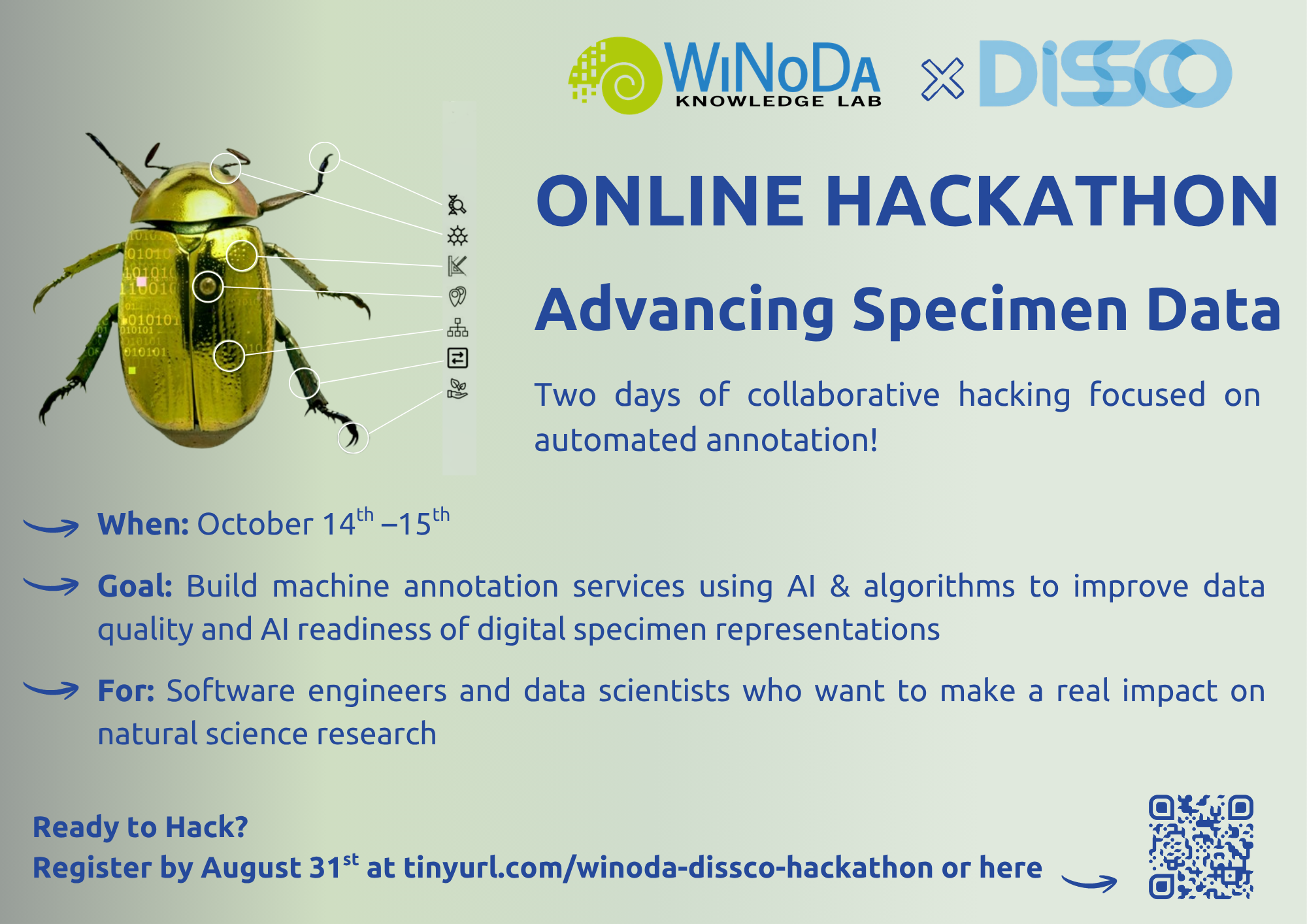
Do you work in a natural history museum and want to make collection data easier to access? Have you built a tool or application and would like to connect it to bigger infrastructures so more people can use the data? Then this year’s DiSSCo x WiNoDa Hackathon is the place for you!
Join us for two days of hands-on hacking with object-related data from natural science collections. Team up with people who share your interests, tackle a challenge together, and bring your ideas to life with support from our experts.
Who are the organisers?
The hackathon is jointly organised by the German Federation for Biological Data (GFBio) and the Naturalis Biodiversity Center.
- GFBio is a leading initiative for biological data management operating across Germany and serves as a core partner of the WiNoDa Knowledge Lab (Data Science in Natural History Collections).
- Naturalis Biodiversity Center, located in Leiden, The Netherlands, is a world-class research institute and natural history museum dedicated to documenting global biodiversity. Naturalis leads the development of the core data infrastructure for DiSSCo (Distributed System of Scientific Collections), which creates digital proxies of specimens in natural history collections known as Digital Specimens.
What are the possibilities?
Working in small teams, you will learn how to develop and connect Machine Annotation Services (MAS) directly to the DiSSCo infrastructure. These automated services act on Digital Specimens to provide critical data quality assessments, error corrections, or links to derived scientific data (such as gene sequences). You can work with specimen data provided by the platform or bring your own datasets (which must be integrated into the infrastructure prior to the event).
Our experts will be on hand to provide both technical and conceptual support.
For this Hackathon we specifically encourage MAS applications that do ground work for other MAS services by annotating image quality and improving AI readiness. Potential MAS applications include, but are not limited to:
- ROI Segmentation: Automatically identifying and isolating areas in an image containing labels, stamps, organisms, mounting materials, rulers, or color bars.
- AI-Readiness & Image Quality Auditing: Evaluating image clarity (blur detection), lighting uniformity, and the orientation or display state of the organism.
- Specimen Condition Analysis: Detecting physical damage, fragmentation, or signs of pest infestation on physical objects.
- Technical Metadata Enrichment: Extracting and validating extended metadata, such as color spaces, compression levels, resolution, and ruler to pixel calculation.
- Historical & Contextual Analysis: Identifying collectors and curators based on handwriting recognition or identifying languages on labels.
Want to see what’s possible?
To get an idea of what previous teams have built, watch the project recap from the last DiSSCo hackathon on Zenodo.
Who can participate?
We particularly welcome software engineers and data scientists who want to make a real impact on research in the natural sciences.
Everyone working with object-based specimen data is also invited to team up in hack teams.
We’re bringing together people from all fields that explore the history of Earth and humankind: biodiversity research, archaeology, geosciences, and more specialised areas like paleontology, archaeobotany, or mineralogy.
We’re also excited to welcome participants from (bio)informatics who are curious to dive deeper into the world of natural science collection data. If you want to learn, experiment, and collaborate across disciplines, this is the perfect place to do it.
What is the schedule?
- August 31: Registration Deadline
- September 14, 3-5 pm: Virtual Kick-Off Meeting
- An introduction to the DiSSCo platform, an overview of potential MAS projects, and a chance to pitch your own ideas. Teams will be finalised by the end of this session.
- October 14–15: The Hackathon
- Two days of intensive, collaborative hacking, culminating in project presentations on the second day.
Have a rough idea or a specific problem you want to tackle? Let us know in the registration form! You can register as an individual or as a pre-formed team.
Further info:
Documentation for MAS developers
If you have any questions, don’t hesitate to contact us via e-mail: winoda@gfbio.org